
Table Of Contents
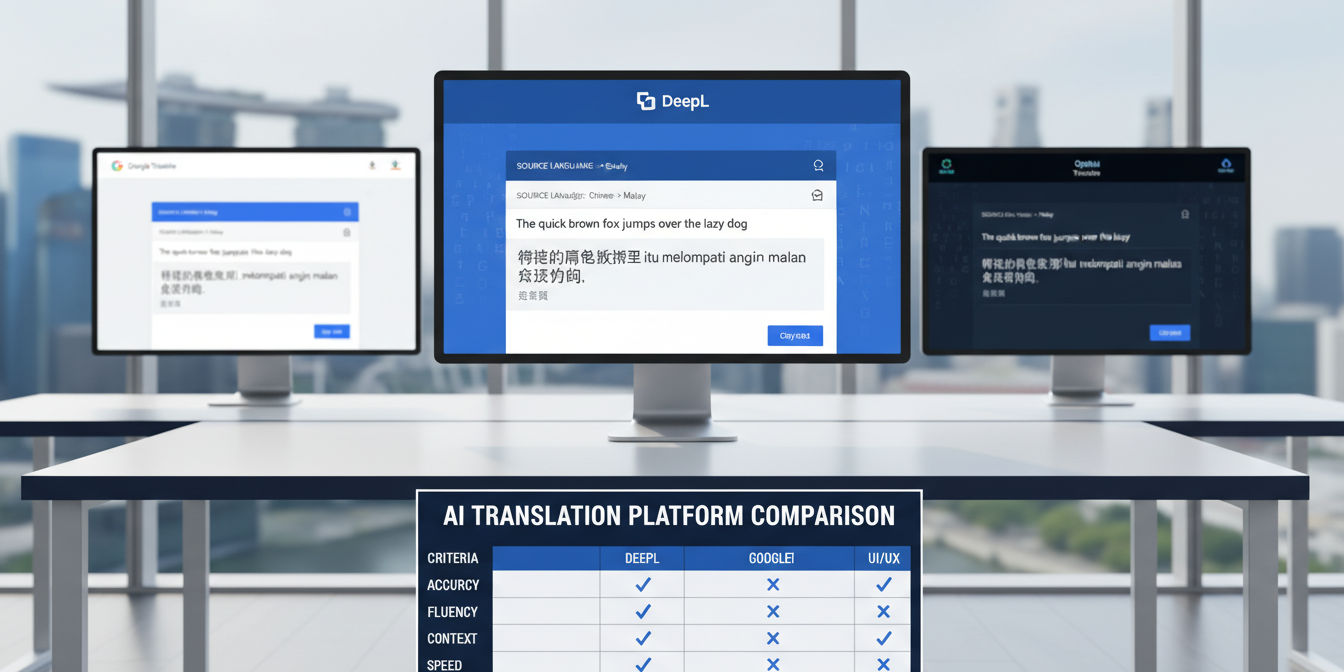
Machine translation has evolved dramatically, with DeepL, Google Translate, and OpenAI’s GPT-based translation capabilities competing for dominance. Each platform uses sophisticated artificial intelligence to break down language barriers, but their approaches and results vary significantly.
For businesses and individuals in Singapore and across the Asia Pacific region, selecting the right translation tool can mean the difference between clear communication and costly misunderstandings. While these AI-powered solutions offer impressive speed and convenience, understanding their strengths and limitations is essential for making informed decisions about your translation needs.
This comprehensive comparison examines real-world performance across multiple languages, analyzing accuracy, contextual understanding, and practical applications. We’ll explore when these free tools suffice and when professional language translation services become necessary for business-critical content.
The Three Giants of Machine Translation
The machine translation landscape has three dominant players, each with distinct origins and philosophies. Google Translate, launched in 2006, pioneered accessible machine translation and now supports over 130 languages. Its massive dataset and continuous refinement through billions of translations have made it the most widely used translation tool globally.
DeepL emerged in 2017 from Germany, focusing on quality over quantity. The platform supports fewer languages but emphasizes natural-sounding translations that capture nuance and tone. DeepL has built a reputation among professional translators and language enthusiasts for producing more sophisticated results, particularly for European languages.
OpenAI’s translation capabilities through ChatGPT and GPT-4 represent the newest approach. Unlike dedicated translation engines, OpenAI’s models leverage broader language understanding developed through training on diverse text sources. This allows them to consider context, cultural references, and stylistic preferences in ways traditional translation engines cannot.
Each platform serves different user needs. Google Translate excels in accessibility and language coverage, DeepL prioritizes translation quality, and OpenAI offers contextual flexibility. Understanding these differences helps users select the appropriate tool for specific translation tasks.
Technology Behind Each Platform
The technological foundations of these platforms reveal why their outputs differ. Google Translate uses Neural Machine Translation (NMT), specifically a Transformer-based architecture that processes entire sentences rather than individual words. This approach, implemented in 2016, dramatically improved translation quality by considering full sentence context. Google’s advantage lies in its massive training dataset drawn from billions of web pages, documents, and human-corrected translations.
DeepL also employs neural networks but with architectural refinements that prioritize linguistic subtlety. The company uses convolutional neural networks combined with advanced attention mechanisms that better preserve meaning across languages. DeepL’s training methodology emphasizes quality over quantity, using carefully curated parallel texts and focusing on fewer language pairs to achieve superior results.
OpenAI’s GPT models take a fundamentally different approach. Rather than being trained specifically for translation, these large language models develop translation capabilities as part of broader language understanding. GPT-4 can consider conversational context, user instructions about tone and style, and cultural appropriateness simultaneously. This flexibility allows users to request specific translation approaches, such as formal business language or casual conversational tone.
Neural Architecture Differences
The architectural distinctions matter in practical applications. Google’s encoder-decoder architecture processes source text through multiple layers, creating an intermediate representation before generating target language output. This works efficiently for straightforward translations but can struggle with ambiguous phrases requiring broader context.
DeepL’s refinements to this architecture include deeper networks with more parameters dedicated to capturing linguistic nuance. The system particularly excels at handling idiomatic expressions and maintaining consistent terminology throughout longer documents. For website translation projects, this consistency proves valuable in maintaining brand voice across pages.
OpenAI’s transformer-based models use self-attention mechanisms that can reference any part of the input text when generating each word of the translation. This allows the system to maintain coherence across longer passages and adapt translation choices based on document-level context, not just sentence-level information.
Quality Test Methodology
To fairly evaluate these platforms, we conducted systematic testing across multiple dimensions. Our methodology examined translations in eight language pairs, focusing on those most relevant to businesses in Singapore and the Asia Pacific region: English to Mandarin Chinese, English to Malay, English to Japanese, English to Korean, and their reverse pairs.
We tested four content categories that represent common translation needs:
- Business communications including emails, meeting notes, and formal correspondence
- Technical documentation such as user manuals and software specifications
- Marketing content including website copy and promotional materials
- Legal and financial texts representing regulated industries with precise terminology requirements
Each translation was evaluated by native speakers with professional translation experience using established quality metrics. We assessed accuracy (correct meaning transfer), fluency (natural expression in target language), terminology consistency, and cultural appropriateness. This approach mirrors the rigorous quality assurance process used by professional translation services.
Translation Accuracy Comparison
Accuracy testing revealed distinct performance patterns. For straightforward business communications, all three platforms achieved acceptable accuracy rates above 85%. Google Translate scored 87%, DeepL reached 92%, and OpenAI (GPT-4) achieved 91% when given appropriate prompts specifying the context and desired tone.
Technical documentation presented greater challenges. DeepL maintained the highest accuracy at 89%, particularly excelling with German, French, and Spanish technical texts. Google Translate scored 84%, occasionally struggling with complex sentence structures containing multiple technical terms. OpenAI showed variable results depending on prompt quality, ranging from 83% to 90%, with better performance when users provided context about the technical domain.
Asian Language Performance
Asian language pairs revealed significant performance gaps. For English to Mandarin Chinese, DeepL produced more natural-sounding translations that native speakers rated as closer to human quality. Google Translate occasionally generated grammatically correct but awkward phrasings that signaled machine translation. OpenAI performed well when instructed to consider regional variations, such as simplified versus traditional characters or mainland versus Taiwanese terminology preferences.
English to Japanese translations highlighted the importance of formality levels. Japanese requires speakers to choose appropriate politeness registers based on context and relationship. DeepL generally selected appropriate registers for business contexts. Google Translate tended toward safe, formal constructions. OpenAI excelled when users specified the relationship context, such as “translating an email from a junior employee to a senior executive.”
For Southeast Asian languages like Malay, Google Translate’s broader language support proved valuable, though translation quality occasionally lagged behind its performance with European languages. The platform’s extensive training data in these languages still provided usable results for general content. However, for business-critical communications requiring cultural sensitivity, professional localization services remain essential.
Context and Nuance Handling
Contextual understanding separates good translations from great ones. We tested this through ambiguous phrases, idiomatic expressions, and culturally specific references. DeepL consistently outperformed on European language idioms, translating phrases like “break the ice” or “hit the nail on the head” into equivalent expressions in the target language rather than literal word-for-word translations.
OpenAI demonstrated superior flexibility when handling culturally specific content. For example, when translating marketing copy containing Western cultural references for an Asian audience, GPT-4 could adapt or explain references when instructed. This capability proves valuable for brands requiring cultural adaptation beyond direct translation.
All platforms struggled with highly ambiguous sentences where meaning depends on broader document context. Consider the English phrase “The board decided to table the discussion.” In American English, this means postponing discussion; in British English, it means beginning discussion. Google Translate and DeepL made translation choices without recognizing this ambiguity. OpenAI, when prompted with information about the document’s origin, could select the appropriate interpretation.
Tone and Register Preservation
Maintaining appropriate tone across languages poses a persistent challenge. Business documents require professional register, marketing content needs persuasive appeal, and casual communications should sound natural and friendly. DeepL generally preserved tone most effectively in its supported languages, producing translations that matched the formality level of source texts.
Google Translate sometimes shifted toward neutral, slightly formal register regardless of source tone. This conservative approach avoids offensive informality but can make casual content sound stiff. For proofreading efficiency, this consistency helps, though it may require human editors to adjust tone.
OpenAI’s ability to follow instructions about tone provided unique advantages. Users can specify “translate this in a warm, friendly tone suitable for customer service” or “maintain a formal, authoritative tone appropriate for legal communication.” This instruction-following capability makes OpenAI particularly valuable for content requiring specific stylistic approaches.
Language Support and Availability
Language coverage varies dramatically among platforms. Google Translate supports over 130 languages, including many low-resource languages with limited digital presence. This breadth makes Google indispensable for users working with uncommon language pairs or needing quick translations across diverse languages.
DeepL supports 31 languages as of early 2026, focusing on European languages plus Japanese, Korean, and Chinese. While this represents significant expansion from DeepL’s European origins, it limits usefulness for businesses requiring Southeast Asian, Middle Eastern, or African languages. The quality within supported languages, however, justifies DeepL’s selective approach for users working within its coverage area.
OpenAI’s GPT-4 handles approximately 80 languages with varying proficiency. Performance correlates with language representation in training data, meaning major world languages receive better results than less common ones. Unlike dedicated translation tools, OpenAI’s capabilities continue expanding through model updates without explicit language additions.
Regional Variant Recognition
Major languages often have significant regional variations. Spanish spoken in Spain differs from Mexican or Argentinian Spanish. Portuguese in Portugal differs from Brazilian Portuguese. Chinese has simplified and traditional character systems plus pronunciation and vocabulary differences across regions.
DeepL recognizes some regional variants, allowing users to specify Portuguese (Brazilian) versus Portuguese (European). Google Translate handles regional variants inconsistently, sometimes offering explicit options, other times defaulting to the most common variant. OpenAI can differentiate regional variants when instructed, such as “translate to Latin American Spanish” versus “translate to Castilian Spanish.”
Best Use Cases for Business
Each platform serves specific business applications most effectively. Google Translate excels for quick, informal translations where perfect accuracy matters less than rapid comprehension. Reading foreign-language customer reviews, understanding competitor websites, or getting the gist of documents in unfamiliar languages represent ideal use cases. The platform’s mobile integration and real-time conversation mode add practical value for travelers and international meetings.
DeepL serves businesses requiring higher-quality draft translations that human translators will refine. Companies translating internal communications, initial drafts of marketing materials, or non-critical business correspondence benefit from DeepL’s superior fluency. The platform integrates with document formats, supporting desktop publishing workflows where translated text must maintain formatting.
OpenAI’s ChatGPT fits specialized translation scenarios requiring contextual adaptation or style-specific translation. Businesses can use it to translate customer service scripts while maintaining empathetic tone, adapt marketing messages for cultural appropriateness, or translate technical content with explanatory notes for non-expert audiences. The conversational interface allows iterative refinement, making it valuable for users who can provide feedback to improve outputs.
Cost Considerations
Pricing structures affect business decisions. Google Translate offers free unlimited use for individuals through its website and apps, with paid API access for businesses integrating translation into applications. Pricing scales with usage volume, making it economical for occasional needs but potentially expensive for high-volume translation.
DeepL provides free translation with character limits and feature restrictions, plus DeepL Pro subscriptions offering unlimited translation, document uploads, and enhanced data security. Business plans include API access and volume-based pricing. For companies regularly translating substantial content volumes in supported languages, DeepL’s subscription model offers predictable costs.
OpenAI charges based on token usage through API access or monthly subscription for ChatGPT Plus. Translation costs depend on text length and model version. For businesses already using OpenAI for other applications, adding translation tasks leverages existing subscriptions efficiently.
Where Machine Translation Falls Short
Despite impressive advances, machine translation cannot yet match human expertise in critical areas. Regulatory and legal documents represent the clearest limitation. Legal terminology carries precise meanings that vary across jurisdictions. Machine translations of contracts, regulatory filings, or legal correspondence risk serious misinterpretation. Singapore government agencies including ICA, MOM, and State Courts require certified translations by qualified professionals, not machine-generated versions.
Financial documents face similar constraints. Annual reports, financial statements, and investor communications require absolute accuracy. Numerical inconsistencies or terminology errors in financial translations create compliance issues and damage credibility. Professional translators specializing in financial services understand regulatory requirements and industry-specific terminology that machine systems miss.
Creative and marketing content demands cultural insight beyond current machine capabilities. Transcreation, the process of adapting marketing messages to resonate with target cultures while preserving intent, requires deep cultural knowledge and creative judgment. Machine translations capture literal meaning but miss emotional resonance, cultural references, and persuasive impact that make marketing effective.
Quality Assurance Limitations
Machine translation systems lack self-awareness about their errors. They produce confident-sounding translations regardless of accuracy. This creates risk when users without target language proficiency cannot verify quality. Subtle errors in machine translations may completely reverse intended meaning, creating potentially serious business consequences.
Professional translation services implement multi-stage quality assurance involving translation, editing, and proofreading by different linguists. This process catches errors that single-pass machine translation misses. For business-critical content, this human oversight remains irreplaceable. The quality assurance process used by established providers ensures accuracy, consistency, and cultural appropriateness across all deliverables.
Choosing the Right Solution
Selecting among these platforms requires assessing your specific needs across several dimensions. Consider the content type and importance first. Internal team communications and informal content can tolerate lower accuracy, making free tools appropriate. Customer-facing content, legal documents, and regulated communications require professional translation to avoid costly errors.
Language pairs matter significantly. For European language combinations, DeepL generally provides best results. For less common languages or broader language coverage, Google Translate’s extensive support proves valuable. When cultural adaptation or style-specific translation matters, OpenAI’s flexibility offers advantages.
Volume and frequency influence cost-effectiveness. Occasional translation needs suit free tools or pay-per-use services. Regular, high-volume translation requirements may justify professional translation partnerships offering volume discounts and consistent quality. Businesses requiring ongoing translation should evaluate whether subscription services or professional translation relationships provide better value.
Consider security and confidentiality requirements. Machine translation platforms process content through cloud servers, creating potential data privacy concerns. Sensitive business information, confidential client data, or proprietary technical details should not be uploaded to free translation services. Professional translation services offer non-disclosure agreements, secure file handling, and compliance with data protection regulations.
Hybrid Approaches
Many businesses benefit from hybrid strategies using machine translation for appropriate tasks while engaging professional translators for critical content. Machine translation can provide initial drafts that human translators refine, potentially reducing costs while maintaining quality. This approach works well for high-volume content like product descriptions or knowledge base articles.
For multimedia content requiring transcription services followed by translation, combining automated transcription with professional translation offers efficiency. The automated first step handles time-consuming audio-to-text conversion, while human translators ensure accurate, culturally appropriate final translations.
Businesses should establish clear guidelines about which content types use machine translation versus professional services. Categories might include internal-only content (machine translation acceptable), external non-critical content (machine translation with human review), and business-critical content (professional translation required). This framework ensures quality where it matters while controlling costs.
DeepL, Google Translate, and OpenAI each offer valuable capabilities for different translation scenarios. DeepL delivers superior quality for European languages and increasingly strong performance in Asian languages within its coverage area. Google Translate provides unmatched language breadth and accessibility for quick comprehension needs. OpenAI offers flexibility and contextual adaptation for specialized translation requirements.
Yet all three platforms share fundamental limitations when handling business-critical content requiring cultural nuance, regulatory compliance, or absolute accuracy. Legal documents, financial communications, marketing transcreation, and certified translations for government agencies demand professional expertise that machine translation cannot yet provide.
For businesses in Singapore and across Asia Pacific, the optimal approach combines these tools strategically. Use machine translation for appropriate tasks while partnering with professional translation services for content where quality, cultural appropriateness, and accuracy directly impact business outcomes. This balanced strategy maximizes efficiency while managing risk effectively.
Need Professional Translation Services?
While machine translation tools continue improving, business-critical content demands the accuracy and cultural insight that only professional translators provide. Translated Right offers comprehensive translation services across 50+ languages, backed by over 5,000 certified translators and trusted by leading brands including AIA, Motorola, and Marina Bay Sands.
Whether you need certified document translations for Singapore government agencies, website localization for international markets, or specialized translation for legal, financial, or technical content, our rigorous quality assurance process ensures accurate, culturally appropriate results.
Contact us today to discuss your translation requirements and discover how professional translation services can support your business success in global markets.