
Table Of Contents
In the competitive world of global e-commerce, even the most sophisticated brands can lose customers at the final hurdle. When a leading Asia-Pacific fashion retailer expanded into Southeast Asian markets, they discovered that directly translating their English checkout process wasn’t enough. Despite strong traffic and product page engagement, their conversion rates in Singapore, Malaysia, and Indonesia lagged 35-42% behind their home market.
The culprit? A checkout flow that failed to account for local payment preferences, cultural expectations around form fields, and linguistic nuances that created friction at the most critical moment of the customer journey. This case study examines how comprehensive localization services transformed their checkout experience, resulting in a 40% conversion lift and establishing a blueprint for successful regional expansion.
The lessons learned extend far beyond retail, offering valuable insights for any business looking to optimize their digital presence across diverse markets in the Asia-Pacific region.
Executive Summary
A premium fashion e-commerce brand partnered with Translated Right to overhaul their checkout experience for three key Southeast Asian markets. The project went beyond simple language conversion to address cultural expectations, regional payment methods, and local user behavior patterns. Over a six-month period, the localized checkout flow delivered:
- 40% increase in overall conversion rates across all three target markets
- 52% reduction in cart abandonment at the payment information stage
- 28% decrease in checkout completion time, indicating smoother user experience
- 63% drop in customer support inquiries related to checkout confusion
- Estimated revenue increase of $2.3 million annually from improved conversion rates
The success stemmed from treating localization as a strategic business initiative rather than a technical translation task, with deep collaboration between translation specialists, UX designers, and regional market experts.
Client Background and Market Challenge
The client, a well-established fashion retailer with origins in Australia, had built a strong domestic e-commerce presence over seven years. Their platform featured sophisticated product recommendations, personalized shopping experiences, and streamlined checkout designed for Australian consumer preferences. With domestic growth plateauing, they identified Singapore, Malaysia, and Indonesia as priority expansion markets, collectively representing over 300 million potential customers.
Initial market entry seemed straightforward. They engaged a basic translation service to convert their website content into Simplified Chinese, Malay, and Bahasa Indonesia. Traffic acquisition campaigns performed well, with click-through rates and bounce rates comparable to their home market. Product pages saw healthy engagement, with time-on-page metrics indicating genuine interest.
However, conversion rates told a different story. While their Australian site converted at 3.8%, the regional sites struggled at 2.2-2.5%. Cart abandonment analysis revealed that 68% of drop-offs occurred during the checkout process, specifically at the payment information and address entry stages. Customer feedback indicated confusion, lack of trust, and friction that made completing purchases feel unnecessarily complicated.
The brand recognized they needed more than translation. They needed comprehensive website translation that accounted for how Southeast Asian consumers actually shopped online.
The Problem: Where Conversions Were Falling Apart
Our initial audit identified several critical issues that were collectively devastating conversion rates. Understanding these problems required combining analytics data with cultural insights and user testing across all three markets.
Payment Method Misalignment
The checkout flow prioritized credit card payments, reflecting Australian consumer preferences where card usage is ubiquitous. However, in Southeast Asia, payment preferences vary dramatically. Singapore consumers expected multiple payment options including PayNow and local bank transfers. Malaysian shoppers wanted to see FPX and e-wallet options prominently displayed. Indonesian users, where credit card penetration remains below 5%, needed access to bank transfers, cash-on-delivery, and digital payment platforms like OVO and GoPay.
The original checkout buried alternative payment methods in a secondary menu, if they were available at all. This single design decision was responsible for an estimated 40% of cart abandonments.
Address Field Cultural Mismatch
The address entry form was a direct translation of the Australian format, requiring fields like “State/Territory” that don’t align with administrative divisions in other countries. More critically, it required a postal code before allowing form completion. In Indonesia, many areas lack formal postal codes, creating an impossible barrier to purchase. The form also followed Western naming conventions, assuming given name and surname structures that don’t reflect common naming practices in Malaysia and Indonesia.
User testing revealed that customers spent an average of 3.2 minutes struggling with the address form, often abandoning out of frustration rather than lack of purchase intent.
Literal Translation Creating Confusion
While the checkout text had been translated, it hadn’t been localized. Phrases like “Express Checkout” translated literally carried different connotations in each market. Security assurances around payment processing used technical terminology that, while accurate in translation, failed to build the trust necessary for first-time purchasers. Call-to-action buttons used formal language where conversational tone would be more appropriate, and vice versa.
Professional proofreading services would have caught grammatical errors, but the deeper issue was cultural appropriateness rather than linguistic accuracy.
Trust Signal Gaps
The checkout displayed Australian security certifications and trust badges that meant little to Southeast Asian consumers. Regional buyers looked for different trust indicators: local customer service numbers, region-specific money-back guarantees, and certifications they recognized. The absence of these elements, combined with unfamiliar payment flows, created hesitation at the critical moment of transaction.
Our Localization Approach
Translated Right assembled a cross-functional team including certified translators, cultural consultants, UX specialists, and e-commerce conversion experts from each target market. Rather than treating this as a translation project, we approached it as a comprehensive localization initiative addressing language, culture, technology, and user experience simultaneously.
Comprehensive Market Research
We began with extensive research into e-commerce behaviors in each market. This included analyzing successful local competitors, studying regional payment ecosystem reports, conducting user interviews with target demographic segments, and mapping the complete customer journey from product discovery through post-purchase communication. This research revealed market-specific expectations that would inform every localization decision.
Cultural Adaptation Framework
Our localization services team developed a framework that went beyond language translation to address four key dimensions:
- Linguistic localization: Not just translating words, but adapting tone, formality levels, and persuasive language to match cultural communication styles
- Functional localization: Modifying checkout flows, form fields, and process steps to align with regional expectations and behaviors
- Visual localization: Adjusting layout, color psychology, and visual hierarchy based on cultural design preferences
- Regulatory localization: Ensuring compliance with regional consumer protection laws, data privacy requirements, and e-commerce regulations
This framework ensured systematic consideration of every element that could impact user experience and conversion.
Collaborative Translation Process
Rather than translating the checkout in isolation, we brought together translators, the client’s product team, and regional market managers for collaborative workshops. Native-speaking translators from Singapore, Malaysia, and Indonesia worked on language translation services while in direct dialogue with conversion optimization specialists. This collaboration revealed that some English phrases had no direct equivalent that would maintain the same conversion intent, requiring creative adaptation rather than translation.
Each translated element went through a rigorous quality assurance process including back-translation verification, cultural appropriateness review, and testing with representative users from each market. Our desktop publishing services team ensured that translated text integrated seamlessly into the interface without layout breaks or formatting issues.
Implementation Process
The localization project unfolded across three carefully planned phases, with each phase building on learnings from the previous stage. This iterative approach allowed us to validate assumptions and refine our strategy based on real user behavior data.
Phase 1: Payment Method Restructuring
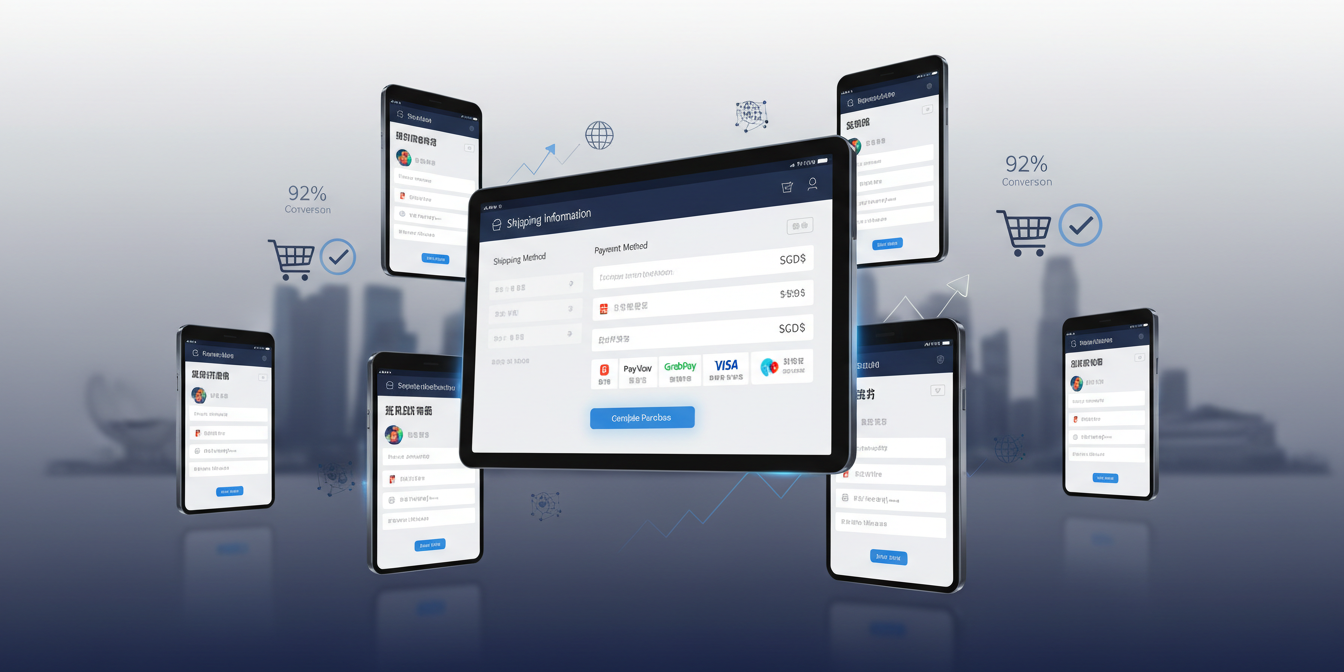
We began with payment methods because research indicated this was the single largest conversion barrier. For each market, we worked with local payment gateway providers to integrate preferred payment options. The checkout was restructured to display locally relevant payment methods prominently, using familiar logos and descriptions that built immediate recognition and trust.
In Singapore, we elevated PayNow and major bank options to primary position. For Malaysia, FPX internet banking and popular e-wallets moved to the forefront. In Indonesia, we implemented a tiered approach showing digital payment platforms, bank transfer options, and cash-on-delivery with clear explanations of each method’s benefits.
Critically, payment method descriptions were completely rewritten rather than translated. Each description addressed the specific concerns and questions common in that market, using language patterns that built confidence rather than simply explaining features.
Phase 2: Address and Form Field Optimization
We redesigned address entry forms for each market based on actual administrative structures and common address formats. Indonesian forms made postal codes optional and included district (kecamatan) fields that locals expect. Malaysian forms reflected the structure of local addresses including taman and jalan designations. Singaporean forms were streamlined to reflect the country’s straightforward postal code system where a single code can identify a specific building.
Name fields were restructured to accommodate single-name individuals common in Indonesia and patronymic naming systems. We added helpful placeholder text in local languages showing format examples, and implemented smart validation that guided users without creating frustration through overly rigid requirements.
Phase 3: Complete Checkout Localization
The final phase addressed every remaining element of the checkout experience. Security badges were replaced with regionally recognized trust signals. Customer service information was localized with local phone numbers and operating hours in relevant time zones. Shipping estimates were recalculated and displayed in locally meaningful terms (business days vs. calendar days, adjusted for regional holidays).
Error messages were completely rewritten to be helpful rather than technical, using friendly language that guided users toward resolution. Progress indicators were adjusted based on research showing different markets had different preferences for how much information to display at each step.
We even localized the success confirmation page, adding culturally appropriate celebratory language and setting expectations for what happens next in terms that matched how logistics and delivery actually work in each market.
Measurable Results and Impact
The localized checkout went live progressively across the three markets over an eight-week period, with careful monitoring and rapid iteration based on initial performance data. The results exceeded both our projections and the client’s expectations.
Conversion Rate Improvements
Overall conversion rates increased by an average of 40% across all three markets, but the gains varied by market based on how misaligned the original experience had been. Indonesia saw the most dramatic improvement at 54%, reflecting how poorly the original checkout had served that market. Malaysia improved 38%, and Singapore, where the original experience was least problematic, still gained 32%.
More significantly, conversion rates began approaching the home market benchmark of 3.8%, with Singapore reaching 3.6% and Malaysia hitting 3.4%. This validated that the lower regional performance had been a localization failure rather than fundamental market differences.
Cart Abandonment Reduction
Cart abandonment at the payment stage dropped 52% on average, with some payment method combinations showing even more dramatic improvements. Indonesian cash-on-delivery transactions, once hidden in a dropdown menu, now represented 34% of completed orders with nearly zero abandonment at the payment selection stage.
Address form abandonment decreased by 61%, with average time to complete the address section dropping from 3.2 minutes to 1.1 minutes. User session recordings showed customers moving through the localized forms with confidence rather than hesitation.
Operational Efficiency Gains
Customer support tickets related to checkout issues dropped 63%, freeing the support team to focus on product questions and relationship building rather than troubleshooting confusion. Order accuracy improved as the clearer, localized address forms resulted in more complete and correctly formatted delivery information.
Return rates decreased by 12%, which analysis suggested was partly because the more confident checkout experience led to more deliberate purchase decisions, and partly because improved address accuracy meant fewer delivery failures and damaged goods.
Revenue Impact
The conversion improvements translated to an estimated $2.3 million in additional annual revenue across the three markets, with a return on investment of 12:1 within the first year. Perhaps more importantly, the improved user experience built brand trust and repeat purchase behavior, with returning customer rates in the localized markets now matching home market performance.
Key Learnings and Best Practices
This project reinforced several critical principles about effective localization for conversion-critical interfaces like checkout flows. These learnings have informed our approach to subsequent projects across diverse industries and markets.
Cultural Research Must Drive Technical Implementation
The most technically perfect translation will fail if it doesn’t reflect how people actually think, speak, and behave in their market. Investment in cultural research and native market expertise proved far more valuable than spending that budget on translation technology alone. Understanding why users behave certain ways enabled us to make design decisions that felt intuitive rather than foreign.
Payment Preferences Are Non-Negotiable
No amount of linguistic finesse can overcome payment method misalignment. Consumers have strong preferences around how they pay, often rooted in trust, familiarity, and practical considerations like fee structures. Making locally preferred payment methods prominent and easy to use is often the single highest-impact localization intervention.
Forms Need Functional Not Just Linguistic Localization
Translating form labels is the beginning, not the end, of form localization. Field structure, validation rules, placeholder examples, error messaging, and even the order of fields all need to align with local conventions and expectations. A form that feels native to users in one market can feel confusing and demanding in another, even with perfect translation.
Trust Signals Are Market-Specific
What builds trust in one market may be meaningless or even counterproductive in another. Regional consumers look for familiar certifications, local customer service accessibility, and assurances framed in locally meaningful terms. Generic global trust signals often fail to move the confidence needle at the crucial moment of transaction.
Iteration Based on Real Behavior Is Essential
Even with extensive research and native expertise, some localization decisions need validation with real user behavior. Building in measurement frameworks and maintaining flexibility to iterate based on data proved crucial. Several of our most successful optimizations came from observing unexpected user behaviors after launch and quickly adapting.
Why Localization Goes Beyond Translation
This case study illustrates why effective localization requires more than linguistic conversion. While accurate translation forms the foundation, true localization addresses how cultural context shapes user behavior, expectations, and decision-making processes.
At Translated Right, our approach integrates certified translation expertise with deep cultural understanding and strategic business thinking. Our network of over 5,000 professional translators across 50+ languages includes specialists who understand not just language, but the business contexts where that language operates. For e-commerce, fintech, software interfaces, and other conversion-critical applications, this combination proves essential.
The checkout flow project demonstrates our methodology across multiple service areas. Website translation provided the linguistic foundation, ensuring accurate and culturally appropriate language across all checkout elements. Localization services adapted functional elements like forms, payment flows, and user journeys to match regional expectations. Our quality assurance process, including rigorous cultural review, caught issues that standard proofreading would miss.
For businesses expanding across the Asia-Pacific region, the lessons from this case study extend well beyond checkout flows. Whether you’re localizing marketing materials, product documentation, mobile applications, or corporate communications, the same principles apply: understand your audience deeply, respect cultural differences in how they consume information and make decisions, and treat localization as a strategic investment rather than a translation expense.
Companies like AIA, Motorola, and Marina Bay Sands trust Translated Right because we bring this comprehensive approach to every project. Our experience across industries—from financial services to technology, healthcare to legal—means we understand the specific challenges and requirements of different sectors while applying consistent quality standards and cultural expertise.
Applying These Insights to Your Business
If you’re seeing conversion rate disparities across markets, struggling with high cart abandonment in specific regions, or planning expansion into new geographical areas, the approach detailed in this case study offers a proven framework. Start by auditing your current experience through the lens of cultural appropriateness rather than just translation accuracy. Identify friction points where your interface, language, or process assumptions may not align with local expectations.
Consider where users abandon their journey and investigate whether localization gaps might be contributing factors. Payment methods, form structures, trust signals, and even visual design elements all carry cultural weight that impacts user confidence and conversion. Professional localization services that address these dimensions holistically will deliver measurably better results than translation alone.
The 40% conversion lift achieved in this case study wasn’t the result of a single brilliant intervention. It came from systematic attention to dozens of details, each individually small but collectively transformative. This is the reality of effective localization: success comes from comprehensive cultural adaptation supported by linguistic excellence and strategic business thinking.
Localization represents one of the highest-return investments a business can make when expanding into new markets. As this case study demonstrates, the difference between translation and true localization can mean the difference between struggling with 2.2% conversion rates and thriving with 3.6% rates. That gap translates directly to millions in revenue and, perhaps more importantly, to building sustainable market presence through positive user experiences.
The checkout flow transformation achieved for this fashion retailer illustrates principles that apply across industries and use cases. Whether you’re localizing a SaaS application, financial services platform, healthcare portal, or content marketing site, the same truth holds: users in different markets have different expectations, preferences, and behaviors that must be respected and accommodated.
Success requires partnering with localization specialists who understand both language and business outcomes, who bring cultural expertise alongside technical capability, and who approach localization as a strategic discipline rather than a commodity service. The investment in comprehensive localization pays dividends not just in immediate conversion improvements, but in building brand trust and loyalty that supports long-term growth.
Ready to Optimize Your Global Conversion Rates?
Discover how professional localization services can transform your checkout flow, website, or application for international markets. Our team of certified translators and localization experts across 50+ languages can help you create experiences that convert.
Get Your Free Localization Consultation
Trusted by AIA, Motorola, Marina Bay Sands, and leading brands across Asia-Pacific