
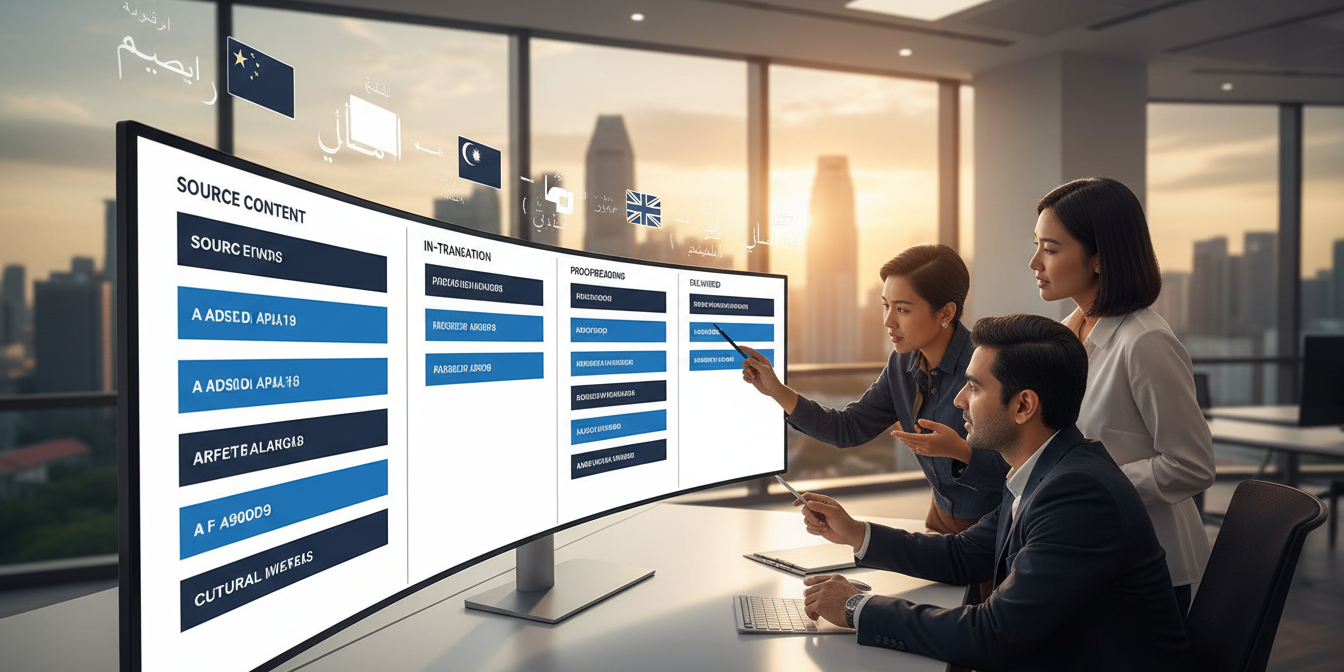
Global content timelines rarely wait. A product launch in Singapore cannot pause while translated copy queues behind a backlog of tasks, and a marketing campaign targeting Southeast Asian markets loses momentum every day its localised assets sit unreviewed. For organisations managing multilingual content at speed, the traditional waterfall approach to translation — submit, wait, receive, repeat — simply does not scale. That is where Agile localisation, supported by a well-structured Kanban board, becomes a genuine operational advantage.
An Agile localisation Kanban board gives translation teams, project managers, and content stakeholders a shared, real-time view of where every piece of content sits in the localisation pipeline. It surfaces bottlenecks before they become delays, ensures quality steps like proofreading and cultural review are never skipped under pressure, and allows teams to prioritise the highest-value work at any given moment. This guide walks you through exactly how to set one up — from defining your board columns to managing multi-language projects without losing visibility.
Kanban Board Setup for Multilingual Teams
A visual summary of how to build an Agile localisation workflow that reduces delays, surfaces bottlenecks early, and delivers translated content faster across global markets.
Key Takeaways
Continuous Flow Over Batches
Kanban’s pull-based system handles uneven translation requests without forcing artificial sprint cycles, keeping content moving steadily.
WIP Limits Prevent Bottlenecks
Setting work-in-progress limits per stage stops queues from forming at proofreading and cultural review — the most common chokepoints.
Cultural Review Is Non-Negotiable
A dedicated cultural review stage catches market-specific sensitivities that grammar checks alone will miss, protecting brand reputation.
Single Source of Truth
The board must be the authoritative status hub. All updates happen in real time, eliminating duplicate tracking via email or spreadsheets.
The 8-Stage Localisation Pipeline
Every content card flows through these Kanban columns →
›
›
›
›
›
›
›
7-Step Board Setup Guide
Map Your Real Workflow
Interview translators, PMs, and stakeholders. Build the board around actual process, not an idealised one.
Define Your Card Template
Standardise language pairs, content type, word count, due date, and domain-specific notes on every card.
Build Your Columns
Use the 8-stage pipeline as a baseline, adding or removing stages to match your organisation’s process.
Set WIP Limits
Start with team size + 1 per column. Track cycle time and refine limits as data accumulates.
Add Language Swimlanes
Separate Simplified Chinese, Malay, Japanese, and other languages into horizontal swimlanes for clarity.
Run a Calibration Session
Walk through 2–3 real tasks before launch. Fix gaps in columns or card data before scaling up.
Retrospect Regularly
Hold weekly or biweekly reviews. Use cycle time and throughput data to drive one or two improvements each cycle.
Recommended Kanban Tools by Team Size
Best Practices for Long-Term Success
- Move cards in real time — not in batch updates — so bottlenecks surface within hours, not the next morning.
- Use a Blocked swimlane so stalled cards remain visible without polluting active workflow columns.
- Review cycle time, throughput, and blocker frequency monthly to surface systemic issues, not just task-level ones.
- Share a read-only board view with your external translation partner to align on delivery priority and schedule.
- Treat the board as a living management tool, not a reporting artefact — adjust structure as workflows evolve.
What Is Agile Localisation and Why Does It Matter?
Agile localisation applies the core principles of Agile project management — iterative delivery, continuous collaboration, and adaptive planning — to the process of translating and adapting content for different languages and markets. Rather than batching all translation work into a single large release, Agile localisation breaks content into smaller, workable units that move through the pipeline continuously, allowing teams to ship localised versions in parallel with source content development.
For businesses operating across the Asia Pacific region, where markets span languages as diverse as Mandarin, Bahasa Indonesia, Japanese, Tamil, and Vietnamese, the ability to localise quickly and accurately is a competitive differentiator. A delayed localised website or an untranslated product guide can cost a brand real revenue and credibility. Agile localisation frameworks reduce that risk by keeping content flowing steadily rather than accumulating in costly, stressful end-of-project batches. When paired with professional localisation services, Agile methodologies ensure that speed never comes at the cost of cultural accuracy.
Why Kanban Works So Well for Localisation Projects
Among the various Agile frameworks available — Scrum, SAFe, Lean — Kanban is particularly well-suited to localisation work for a straightforward reason: localisation is a continuous, flow-based process rather than a time-boxed sprint activity. New source content is always being created, which means translation requests arrive unevenly and unpredictably. Kanban’s pull-based system, where new tasks are only started when capacity exists downstream, naturally handles this variability without forcing artificial sprint boundaries onto work that does not fit neatly into two-week cycles.
Kanban also provides an instant visual status of every task in the pipeline. For localisation, where a single piece of content may pass through translation, grammar proofreading, editing, and cultural review before it is approved, this visibility is invaluable. Project managers can see at a glance whether a translation is waiting for a reviewer, whether a proofreading task has stalled, or whether a piece of content is ready for desktop publishing. That transparency reduces the need for status update meetings and keeps all stakeholders aligned without constant manual coordination.
The Core Columns Every Localisation Kanban Board Needs
The column structure of your Kanban board should mirror the actual stages your content passes through during localisation. While every organisation’s workflow is slightly different, a robust localisation Kanban board typically includes the following columns:
- Backlog: All identified localisation tasks that have not yet been prioritised or assigned. Source content waiting for translation requests lives here.
- Ready for Translation: Tasks that have been scoped, assigned word counts confirmed, language pairs identified, and are ready for a translator to begin work.
- Translation in Progress: Content actively being translated by a certified linguist. This column should clearly indicate the target language and assigned translator.
- Proofreading and Editing: Translated content under grammar review, stylistic editing, and accuracy checking by a second linguist or senior editor.
- Cultural Review: Content assessed for cultural appropriateness, local idioms, and market-specific sensitivities. This step is often underestimated but is critical for avoiding costly mistranslations in regional markets.
- Client or Stakeholder Review: Approved translations reviewed internally or by the client before final delivery. This is where subject matter expertise from the requesting team adds a final layer of verification.
- Desktop Publishing or Formatting: For localised documents, brochures, or digital assets that require layout adjustments to accommodate text expansion or right-to-left scripts, this stage handles typesetting and formatting.
- Done: Fully approved, formatted, and delivered localised content ready for publication or distribution.
Depending on your workflow, you may also add a Blocked lane — a horizontal swimlane that cards can be moved into when a task is stalled due to missing source files, clarification needed, or resource unavailability. This keeps blocked items visible without polluting the active columns.
Step-by-Step: Setting Up Your Agile Localisation Kanban Board
Setting up an effective Kanban board for localisation does not require expensive software or a lengthy configuration process. The goal is to create a system your team will actually use, and that means keeping it practical and closely aligned with how work actually flows through your organisation.
- Map your current workflow first. Before creating any board, document every step that content currently passes through from source creation to final localised delivery. Interview translators, project managers, proofreaders, and stakeholders. The board should reflect reality, not an idealised process that no one follows.
- Define your card template. Each Kanban card represents one localisation task. Standardise the information each card must include: source language, target language(s), content type (legal document, website copy, marketing material), word count, due date, assigned translator, and any domain-specific notes such as pharmaceutical terminology requirements or legal formatting standards.
- Create your columns based on your workflow map. Use the core columns outlined above as a starting point, then add or remove stages to match your specific process. If your team does not currently perform cultural review as a separate step, consider adding it — it is a quality layer that significantly reduces errors in sensitive markets.
- Set work-in-progress (WIP) limits for each column. WIP limits prevent any single stage from becoming a bottleneck. For example, if your proofreading column has a WIP limit of five cards, no new items enter that stage until one is moved forward, forcing the team to resolve slowdowns proactively rather than letting work pile up.
- Assign swimlanes for language pairs or content streams. If your team handles multiple target languages simultaneously, use horizontal swimlanes to separate, for example, Simplified Chinese from Malay or Japanese from Korean. This gives language-specific teams their own view without losing the overall board structure.
- Run a board calibration session. Before going live, walk your team through the board with two or three real tasks. Identify any columns that feel unclear, any card information that is missing, and any workflow steps that the board does not capture. Adjust before you scale.
- Review and refine in regular retrospectives. Agile localisation is iterative by nature. Schedule brief weekly or biweekly retrospectives where the team reviews board metrics — cycle time, throughput, blocked card frequency — and agrees on one or two process improvements to implement in the next period.
Using WIP Limits to Prevent Localisation Bottlenecks
Work-in-progress limits are one of the most powerful and most overlooked features of Kanban. In localisation workflows, bottlenecks most commonly appear at the proofreading and cultural review stages, where specialist resources are often limited and demand from upstream translation work is high. Without WIP limits, these stages fill up with queued cards while translators continue pushing work through, creating a backlog that erodes deadlines and quality.
A practical starting point is to set WIP limits equal to the number of people working in each stage plus one. So if two proofreaders handle your editing column, set the WIP limit at three. This allows a small buffer without creating a queue. Over time, track your cycle time data — how long cards spend in each column — and use that data to refine your limits. If cultural review consistently holds cards for longer than translation, that is a signal to either increase reviewer capacity or reduce the WIP limit upstream to slow the inflow of new work.
Managing Multi-Language Projects on a Single Board
One of the more complex challenges in localisation project management is maintaining visibility across multiple target languages without fragmenting your board into an unmanageable collection of separate systems. A well-configured single Kanban board can handle this through a combination of swimlanes, card labels, and colour coding.
Use swimlanes to separate major language groups or client projects. Use colour-coded labels on individual cards to denote the target language at a glance — for instance, blue for Simplified Chinese, green for Bahasa Malay, orange for Thai. This allows a project manager to scan the board quickly and understand the status of each language pair without opening every card. For organisations working across 50 or more languages, as is the case with large enterprise localisation programmes, a tiered board structure may be necessary: a high-level programme board showing language stream status, with linked sub-boards for each language pair containing the detailed card-level workflow.
It is also worth considering how your board connects to supporting services. For example, content that requires professional proofreading after translation, or assets that need desktop publishing and typesetting before delivery, should have dedicated columns that make these dependencies explicit on the board rather than managing them as invisible offline tasks.
Recommended Tools for Your Localisation Kanban Workflow
Choosing the right tool depends on your team size, budget, and the complexity of your localisation programme. The following options are well-suited to different contexts:
- Jira: The most feature-rich option for enterprise teams, with advanced swimlane configuration, WIP limit enforcement, and integration with translation management systems (TMS). Best suited for large, multi-language programmes with dedicated project managers.
- Trello: An intuitive, visual option for smaller teams or organisations new to Kanban. Power-Up integrations can add WIP limit enforcement and card aging visibility. Ideal for teams managing a limited number of language pairs.
- Asana: Offers board views with timeline integration, which is useful for localisation projects with hard launch deadlines. Works well for marketing and content teams that also manage non-localisation tasks in the same tool.
- Monday.com: Highly customisable with strong reporting features. Good for teams that want dashboard-level visibility across multiple language project streams without heavy technical configuration.
- Phrase (formerly Memsource) or memoQ: Dedicated translation management systems that include built-in workflow features and can be used alongside a general Kanban tool for operational tracking. These are particularly valuable if your team works with a large network of translators and needs TM (translation memory) and glossary integration.
For teams working with external translation partners, the board tool should support external collaborator access or at minimum allow status exports that can be shared with the partner agency for alignment on priority and delivery schedules.
Best Practices for Sustaining an Agile Localisation Process
A Kanban board is only as effective as the habits built around it. The most common reason localisation boards fail is not poor configuration — it is inconsistent usage. Cards do not get updated, columns are skipped, and the board quickly stops reflecting reality. The following practices help teams sustain Agile localisation discipline over the long term.
- Make the board the single source of truth. All localisation status conversations, whether in email, messaging tools, or meetings, should reference the board rather than duplicate it. If someone asks for a status update, the answer should be: check the board.
- Update cards in real time, not end of day. Encourage translators and reviewers to move cards as soon as work on a stage is complete, not in a batch update at the end of the day. Real-time updates allow project managers to identify and respond to bottlenecks within hours rather than the following morning.
- Capture blockers immediately. When a card is stuck — waiting for a source file, a terminology decision, or a client approval — move it to the blocked lane and add a note explaining the blocker. This makes it impossible for stalled work to hide in the active columns.
- Review board metrics monthly. Track average cycle time per stage, number of cards delivered per week, and blocker frequency by type. These metrics reveal systemic issues that individual task tracking cannot surface, and they provide the data you need to make a business case for additional resources or process changes.
- Align your board with your localisation services partner. If you work with an external agency, share a read-only view of your board or establish a regular cadence for status alignment. This is particularly important for projects involving website translation or transcription services, where deliverables feed directly into other production workflows.
The teams that sustain effective Agile localisation programmes over time are those that treat the Kanban board as a living management tool rather than a reporting artefact. Regular retrospectives, committed daily usage, and a willingness to adjust the board structure as workflows evolve are the habits that separate high-performing localisation operations from those that revert to email chains and spreadsheets within a month of launch.
Conclusion
Setting up an Agile localisation Kanban board is one of the most practical investments a multilingual content team can make. It replaces opaque, email-driven coordination with a shared, transparent system that surfaces bottlenecks early, keeps quality steps visible, and allows teams to deliver localised content faster without compromising accuracy. Whether you are managing website translations for a regional product launch, coordinating certified document translations for regulatory submission, or running a continuous localisation programme across a dozen languages, a well-structured Kanban board gives your operation the structure it needs to scale.
The key is to start with a board that reflects your actual workflow, enforce WIP limits from day one, and commit to using the board as the single source of truth for all localisation status. Refine it as your team grows and your content volumes increase. The methodology rewards consistency and continuous improvement — which, conveniently, is exactly what Agile is designed to deliver.
Ready to Streamline Your Localisation Workflow?
Whether you are building your first Agile localisation process or scaling an existing multilingual content operation, Translated Right has the expertise and resources to support you. With over 5,000 certified translators across 50+ languages and a rigorous multi-stage quality assurance process, we help businesses across Singapore and the Asia Pacific region deliver accurate, culturally appropriate translations — on time, every time.