
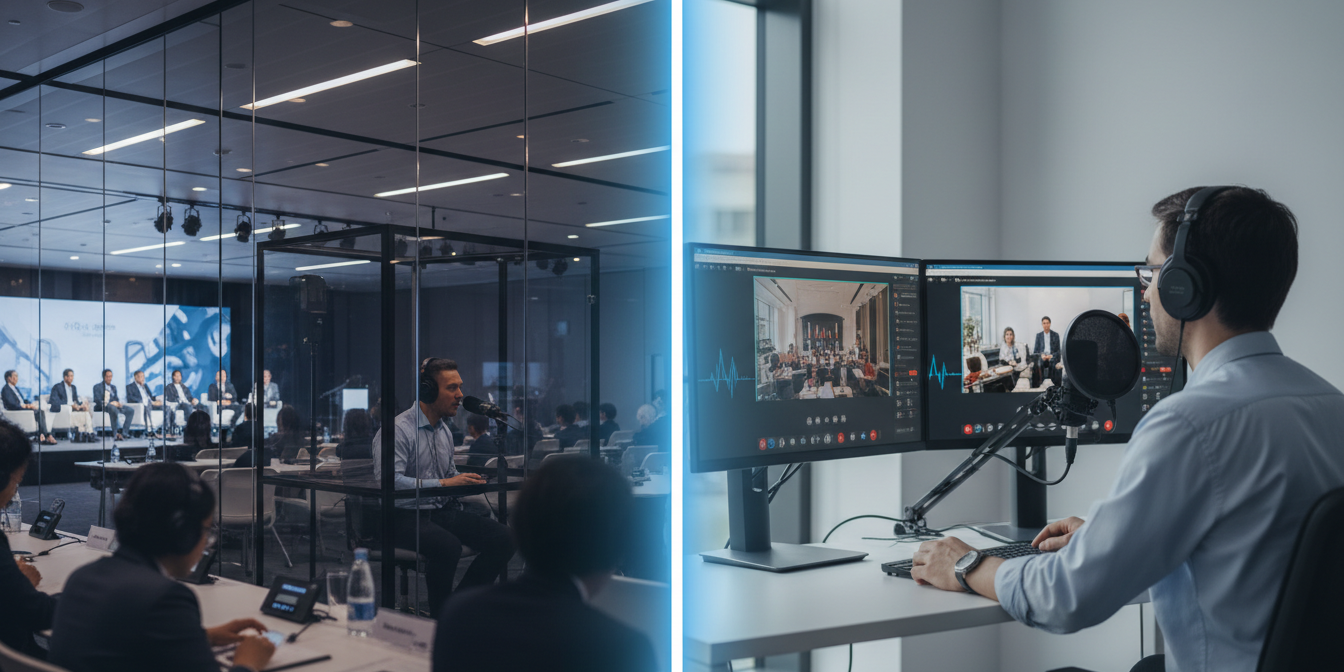
Planning a multilingual event in Singapore or across the Asia Pacific region means making one critical decision early: will your interpreters be physically present on-site, or will they deliver interpretation remotely via a simulcast platform? Both live event interpretation and remote simultaneous interpretation (RSI) can deliver high-quality multilingual support, but each comes with its own set of advantages, limitations, and ideal use cases.
As hybrid and virtual events have become the norm alongside traditional in-person conferences, the interpretation landscape has shifted significantly. Government summits, international business conferences, legal proceedings, and corporate town halls all have different demands — and the wrong choice can affect communication quality, audience engagement, and your overall event budget. This guide breaks down the key differences, pros, and cons of each approach so you can make an informed decision for your next event.
What Is Live Event Interpretation?
Live event interpretation — often called on-site simultaneous interpretation — involves professional interpreters physically attending your event and delivering real-time translation from soundproofed booths. Audiences receive the interpreted audio through wireless receivers or earpieces, allowing them to follow proceedings in their preferred language without any delay. This is the format most commonly associated with international conferences, United Nations-style assemblies, and high-profile diplomatic events.
In Singapore, live interpretation is frequently used at government forums, legal hearings, and major MICE (Meetings, Incentives, Conferences, and Exhibitions) events hosted at venues such as Marina Bay Sands and Suntec Convention Centre. The setup typically requires interpretation booths, audio distribution equipment, and a team of certified interpreters who work in pairs, rotating every 20 to 30 minutes to maintain accuracy and prevent fatigue.
What Is Remote Simulcast Interpretation?
Remote simultaneous interpretation, or RSI, is a technology-enabled model where interpreters work from a remote location — either a professional studio or their own dedicated home setup — and deliver real-time interpretation via a cloud-based platform. Participants access the interpreted audio through a web browser, mobile app, or integrated conferencing platform such as Zoom, Microsoft Teams, or dedicated RSI platforms like Interprefy or KUDO.
RSI gained significant traction during the global shift to virtual and hybrid events and has since become a mainstream option even for in-person gatherings that include remote participants. Rather than requiring physical infrastructure at the venue, the entire system operates digitally, making it more flexible and often more cost-efficient for organisations operating across multiple locations or time zones.
Pros of Live Event Interpretation
Superior Audio Quality and Environmental Awareness
On-site interpreters have direct access to the acoustic environment of the event. They can hear speakers clearly, respond to ambient cues, and immediately alert technical staff if there are audio issues. This direct feedback loop contributes to a smoother, more natural interpretation experience, particularly for events with complex Q&A sessions, spontaneous interactions, or panel discussions where multiple voices overlap.
Stronger Contextual Understanding
Being physically present allows interpreters to read visual cues — a speaker’s body language, presentation slides, physical demonstrations, or on-stage props — all of which add layers of context that can inform word choice and tone. For technical or highly specialised events, such as pharmaceutical conferences or legal arbitrations, this contextual richness reduces the risk of misinterpretation.
Ideal for High-Stakes and Formal Settings
Certain events simply demand the formality and reliability of in-person interpretation. State-level meetings, legal proceedings, and international trade negotiations benefit from the professional gravitas that on-site interpretation teams provide. The physical presence of interpreters also reassures organisers and delegates that the language support infrastructure is robust and immediately accountable.
Cons of Live Event Interpretation
Higher Logistical Costs
Live interpretation requires significant investment in physical infrastructure. Soundproofed interpretation booths, wireless receiver systems, and technical support staff all add to your event budget. For multi-language events — say, requiring simultaneous interpretation into four or five languages — the cost of booths, equipment rentals, and interpreter travel can escalate quickly. Organisations managing tight budgets may find this model challenging to sustain, especially for regular recurring events.
Geographic and Availability Constraints
Finding certified interpreters for less common language pairs who are available to travel to your venue on specific dates can be difficult, particularly in niche languages or highly technical subject areas. Last-minute cancellations or travel disruptions can create serious contingency challenges when your interpreters need to be physically present at a fixed location.
Limited Scalability for Hybrid Events
If your event includes a significant proportion of remote attendees, live on-site interpretation alone does not easily extend to those participants without additional technical integration. This creates a two-tier experience where in-person attendees benefit from seamless interpretation while online participants may receive a degraded or delayed version, undermining the inclusivity of your event.
Pros of Remote Simulcast Interpretation
Cost Efficiency and Flexibility
Remote interpretation eliminates the need for physical booth installation, equipment hire, and interpreter travel expenses. For organisations hosting multilingual webinars, virtual town halls, or hybrid conferences on a regular basis, RSI can represent substantial savings over time. The ability to scale the number of language channels up or down with relatively little lead time also gives event planners much greater flexibility during the planning process.
Access to a Wider Pool of Interpreters
Because interpreters can work from anywhere in the world, RSI dramatically expands your access to certified professionals across rare language pairs and specialised domains. If your event requires interpretation into Bahasa Indonesia, Tamil, Tagalog, or a regional dialect alongside standard conference languages, remote platforms make it far more feasible to source qualified interpreters without geographic limitations.
Seamless Integration with Virtual and Hybrid Events
RSI is purpose-built for the modern event format. Whether your participants are joining from Singapore, London, Tokyo, or Sydney, everyone receives the same quality of interpreted audio through the same digital platform. This parity of experience is increasingly important for global organisations that want consistent, professional multilingual support regardless of where attendees are located.
Cons of Remote Simulcast Interpretation
Technology Dependency and Connectivity Risks
The quality of remote interpretation is directly tied to internet connectivity at both ends — the interpreter’s location and the participant’s device. Latency, audio dropouts, or platform instability can disrupt the interpretation stream at critical moments. Unlike on-site interpretation where a technical issue is visible and immediately addressable, remote failures can be harder to diagnose and resolve in real time, potentially leaving multilingual attendees without support during important segments of your event.
Reduced Environmental Context for Interpreters
Remote interpreters rely entirely on the audio and video feed provided to them, which may not capture all the nuance of an in-person setting. Poor camera placement, inconsistent microphone quality, or sudden speaker changes can challenge interpreters who are working without the benefit of being physically present. This limitation is particularly relevant for dynamic, fast-paced events with unpredictable formats.
Platform Fatigue and User Adoption
Not all participants are equally comfortable navigating digital interpretation platforms. Older delegates, government representatives, or attendees in regions with lower digital literacy may find the process of selecting a language channel and managing their audio settings confusing. Providing adequate technical support and clear onboarding instructions is essential but adds another layer of coordination to your event logistics.
Key Factors to Consider When Choosing
Choosing between live and remote interpretation is not purely a cost calculation — it requires a holistic look at your event’s specific requirements. Before making your decision, consider the following:
- Event format: Is the event fully in-person, fully virtual, or hybrid? RSI naturally suits virtual and hybrid formats, while live interpretation is better suited to in-person gatherings.
- Number of languages: Events requiring interpretation into many languages simultaneously may be more cost-effective via RSI, where additional language channels can be added digitally.
- Subject matter complexity: Highly technical, legal, or sensitive subject matter may benefit from the heightened contextual awareness of on-site interpreters.
- Audience size and location: Large, geographically dispersed audiences are better served by RSI, whereas smaller, co-located audiences may justify the investment in live interpretation.
- Budget and lead time: RSI often requires less logistical lead time and can be more budget-friendly, making it suitable for events with shorter planning windows.
- Internet infrastructure at the venue: If your venue has unreliable connectivity, RSI carries higher risk and a live interpretation setup may be more dependable.
Beyond these operational factors, it is also worth considering your brand’s reputation and your audience’s expectations. For premium events associated with major brands or government bodies, the professionalism of a fully equipped on-site interpretation team can reinforce credibility and trust in ways that are difficult to replicate remotely.
Which Option Is Right for Your Event?
There is no single right answer — the best interpretation model depends on the specific context of your event, your audience, and your goals. For formal, high-stakes in-person events such as government summits, legal arbitrations, or flagship international conferences, live on-site interpretation remains the gold standard. The investment in quality, reliability, and professional presence is justified by the nature of the event itself.
For virtual conferences, hybrid corporate meetings, recurring multilingual webinars, or events spanning multiple international time zones, remote simulcast interpretation offers a compelling combination of flexibility, cost efficiency, and broad language coverage. As RSI platforms continue to mature and participants become more comfortable with digital event infrastructure, remote interpretation is increasingly capable of meeting the demands even of sophisticated, large-scale multilingual events.
A growing number of organisations are also adopting a hybrid interpretation model — deploying on-site interpreters for in-person delegates while simultaneously streaming interpretation to remote participants through an RSI platform. This approach delivers the best of both worlds, though it does require careful coordination between your technical team, interpretation provider, and event platform.
For organisations looking to support multilingual communication beyond live events — including translating event materials, presentations, websites, or post-event documentation — professional language translation services play an equally important role. From localisation services that adapt your content for specific regional audiences to transcription services that convert recorded sessions into accurate multilingual text, a comprehensive language partner can support every stage of your event’s communication lifecycle. Well-prepared materials, backed by thorough proofreading and cultural review, ensure your message lands with precision and impact across every language channel.
Final Thoughts
Live event interpretation and remote simulcast each offer distinct advantages that make them well suited to different event contexts. On-site interpretation delivers unmatched audio quality, contextual depth, and professional presence for high-stakes in-person events. Remote simulcast interpretation offers flexibility, cost efficiency, and global reach for virtual, hybrid, and large-scale multilingual gatherings. The right choice depends on carefully evaluating your event format, audience expectations, budget, and the complexity of the subject matter being discussed.
As multilingual communication becomes an ever more essential element of professional events across Singapore and the broader Asia Pacific region, working with an experienced language services partner ensures your interpretation and translation needs are handled with accuracy, cultural sensitivity, and genuine expertise.
Need Expert Language Support for Your Next Event?
Translated Right provides professional interpretation coordination, document translation, localisation, and transcription services trusted by leading organisations across Singapore and Asia Pacific. Whether you are planning an international conference, a government forum, or a hybrid corporate event, our team of over 5,000 certified translators and language specialists is ready to help.