
Table Of Contents
- Understanding the Voice-Over and Dubbing Landscape
- AI Voice-Over Technology: Capabilities and Limitations
- Human Dubbing: The Gold Standard for Quality
- Cost Comparison: Investment vs. Value
- When to Choose AI Voice-Over
- When to Choose Human Dubbing
- Quality Considerations for Both Approaches
- The Hybrid Approach: Best of Both Worlds
- Future Trends in Voice-Over and Dubbing
The explosion of video content across global markets has created an urgent need for efficient, high-quality voice-over and dubbing solutions. As businesses expand their reach across language barriers, they face a critical decision: should they invest in traditional human dubbing or embrace the speed and affordability of AI-generated voice-overs? This choice can significantly impact audience engagement, brand perception, and your bottom line.
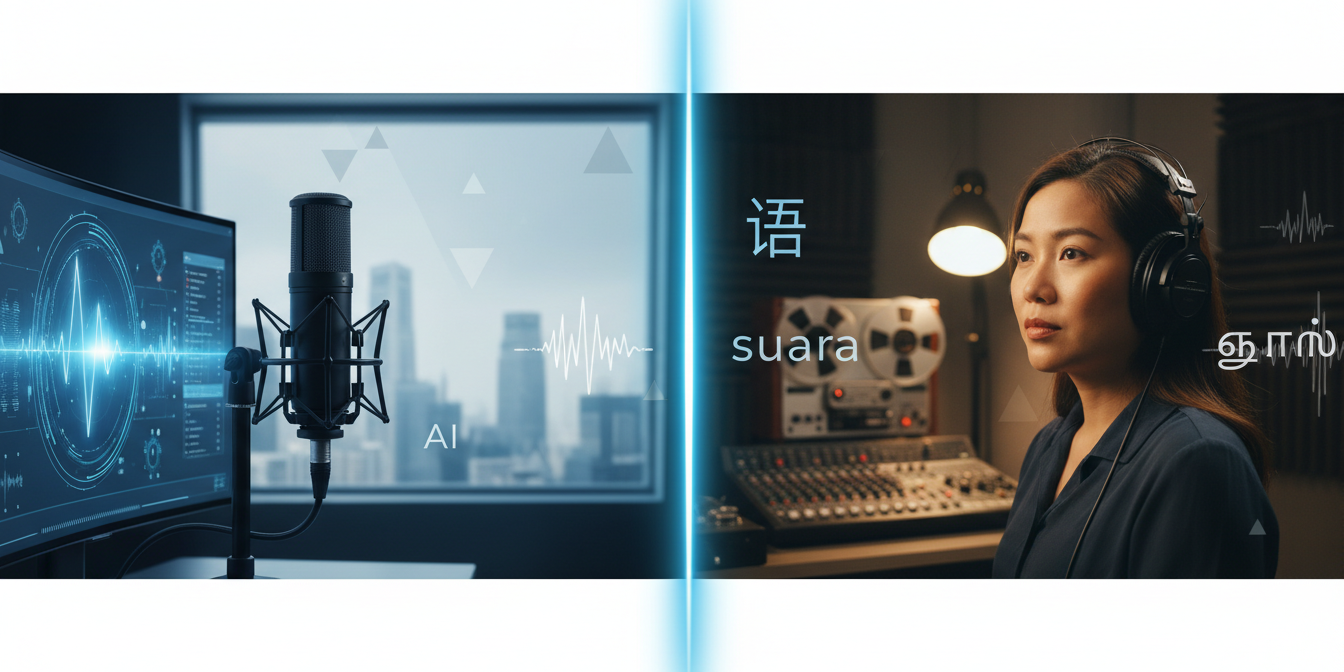
Recent advances in artificial intelligence have made AI voice-over technology remarkably sophisticated, capable of producing natural-sounding speech in dozens of languages within minutes. Meanwhile, professional human dubbing continues to set the standard for emotional authenticity and cultural nuance, particularly for high-stakes content where brand reputation is on the line. Neither solution is universally superior; the right choice depends on your specific content type, audience expectations, budget constraints, and quality requirements.
In this comprehensive guide, we’ll examine both AI voice-over and human dubbing through a practical lens, helping you understand when each approach makes the most sense for your multimedia projects. Whether you’re localizing e-learning modules, marketing videos, corporate presentations, or entertainment content, you’ll gain the insights needed to make informed decisions that balance quality, cost, and timeline considerations.
Understanding the Voice-Over and Dubbing Landscape
The voice-over and dubbing industry has undergone dramatic transformation over the past five years. What once required booking studio time, coordinating with voice talent, and waiting days or weeks for deliverables can now be accomplished in hours using sophisticated AI platforms. However, this technological leap hasn’t eliminated the need for human expertise; it’s simply expanded the range of options available to content creators and businesses.
Voice-over typically refers to a recorded voice track that plays over video content, often used for narration, explanations, or commentary. The speaker isn’t visible on screen, and the focus remains on conveying information clearly. Dubbing, on the other hand, involves replacing the original dialogue in a video with translated speech that matches the lip movements and timing of on-screen speakers. This synchronization requires significantly more skill and precision, whether performed by AI or humans.
Modern businesses need both types of audio localization depending on their content. A corporate training video might only require voice-over narration, while a customer testimonial video would benefit from precise dubbing to maintain authenticity. Understanding these distinctions helps frame the AI versus human decision more accurately, as the technical requirements differ substantially between the two approaches.
The rise of global digital platforms has created unprecedented demand for multilingual content. Companies can no longer afford to produce content in just one or two languages if they want to compete internationally. This volume challenge has accelerated AI adoption while simultaneously highlighting situations where human quality remains irreplaceable. The question isn’t whether AI will replace humans entirely, but rather how to strategically deploy each approach for maximum impact.
AI Voice-Over Technology: Capabilities and Limitations
Artificial intelligence voice-over technology has progressed from robotic, monotone output to remarkably natural-sounding speech synthesis. Modern AI systems use neural networks trained on thousands of hours of human speech, enabling them to replicate intonation patterns, breathing rhythms, and even emotional inflections. Top platforms now offer voice cloning capabilities, allowing you to create consistent brand voices across multiple projects and languages.
The primary advantages of AI voice-over center on speed and scalability. You can generate voice-overs in multiple languages simultaneously, update content instantly when scripts change, and produce hours of audio content in the time it would take to schedule a single recording session with human talent. For businesses managing large content libraries or frequently updating information, these efficiency gains translate directly to competitive advantages and cost savings.
Current Capabilities of AI Voice Technology
- Multi-language support: Most AI platforms offer 50+ languages and hundreds of voice options, with varying quality levels across different languages
- Pronunciation customization: Advanced phonetic controls allow you to correct mispronunciations of brand names, technical terms, or acronyms
- Emotional tone adjustment: Better systems let you control speaking style, from professional and serious to casual and friendly
- Speed and pacing control: Easily adjust speaking rate, add pauses, and modify emphasis without re-recording
- Instant iteration: Make script changes and regenerate audio in minutes rather than rescheduling recording sessions
Despite these impressive capabilities, AI voice-over technology still faces significant limitations. The most sophisticated systems occasionally struggle with complex sentence structures, nuanced emotional delivery, or culturally-specific speech patterns. While AI can mimic happiness or excitement, it often lacks the subtle authenticity that human voice actors bring to persuasive or emotionally resonant content. The technology works best for straightforward informational content where clarity matters more than emotional connection.
Another critical limitation involves localization services and cultural adaptation. AI systems can translate and speak words accurately, but they may miss cultural references, idioms, or humor that require human cultural understanding. A phrase that works perfectly in English might sound awkward or even offensive when literally translated and spoken by AI in another language. This is where the cultural review component of professional translation becomes essential, even when using AI for the actual voice synthesis.
Human Dubbing: The Gold Standard for Quality
Professional human dubbing represents the pinnacle of quality in audio localization, combining linguistic expertise, vocal artistry, and cultural intelligence. Experienced voice actors don’t simply read translated scripts; they interpret meaning, convey emotion, and adapt delivery to match the cultural expectations of target audiences. This level of nuance remains beyond current AI capabilities, making human dubbing the preferred choice for content where audience perception directly impacts business outcomes.
The human advantage becomes most apparent in emotionally charged or persuasive content. Marketing videos, brand storytelling, customer testimonials, and entertainment content all rely heavily on emotional authenticity to build trust and drive engagement. A skilled voice actor can convey subtleties like sarcasm, empathy, urgency, or sincerity in ways that feel genuine to native speakers. These performances create emotional connections that influence purchasing decisions, brand loyalty, and message retention far more effectively than even the best AI-generated alternatives.
Human dubbing also excels at handling complex linguistic challenges. Professional voice talent can navigate tongue twisters, rapid dialogue, technical terminology, and culturally-specific references with ease. They understand when to deviate slightly from literal translations to preserve meaning and impact. This interpretive flexibility allows them to maintain the original content’s intent while making it sound natural and engaging in the target language. The collaboration between translators and voice actors through comprehensive proofreading and review processes ensures linguistic accuracy and vocal performance align perfectly.
Key Advantages of Human Voice Talent
- Emotional authenticity: Genuine expression of complex emotions that resonate with audiences on a deeper level
- Cultural fluency: Native understanding of idioms, humor, and cultural references that AI often misses
- Interpretive performance: Ability to make creative decisions that enhance meaning and impact beyond literal translation
- Vocal versatility: Professional actors can modify their delivery style, accent, or character to match different content needs
- Quality consistency: Experienced talent maintains consistent quality across long recording sessions and multiple projects
- Perfect lip-sync: Skilled dubbing artists can match on-screen mouth movements with remarkable precision
The human approach also provides superior quality control through multiple review stages. Professional dubbing workflows typically include translation, adaptation for spoken delivery, voice recording, director review, and final quality checks. This multi-layered process catches errors and ensures the final product meets exacting standards. When working with established providers offering rigorous quality assurance, you benefit from decades of industry expertise and proven methodologies that consistently deliver exceptional results.
Cost Comparison: Investment vs. Value
Understanding the cost structures of AI voice-over versus human dubbing requires looking beyond simple per-minute pricing. While AI platforms typically charge based on character count or audio duration with rates ranging from $10 to $100 per hour of finished audio, human dubbing services generally cost between $100 to $500+ per finished hour depending on language, talent experience, and project complexity. These base numbers, however, don’t tell the complete story.
AI voice-over costs remain remarkably consistent and predictable. You pay for the audio generated, with minimal variation regardless of revisions, multiple takes, or timeline pressures. Many platforms offer subscription models that provide monthly character or minute allowances, making budgeting straightforward for ongoing content needs. For organizations producing large volumes of training materials, product descriptions, or informational content, the cost efficiency of AI becomes compelling when multiplied across dozens or hundreds of projects annually.
Human dubbing costs involve more variables but deliver value that extends beyond the audio file itself. You’re paying for professional expertise, cultural knowledge, and creative interpretation that enhances your content’s effectiveness. The investment includes studio time, voice talent fees, direction, post-production, and quality assurance. While the upfront cost is higher, the return on investment often justifies the expense for customer-facing content, marketing materials, and brand-critical communications where quality directly influences revenue outcomes.
The hidden costs of each approach also merit consideration. AI-generated content may require more internal review time to catch unnatural phrasing or pronunciation errors, potentially necessitating multiple regenerations. Poor-quality AI voice-overs can damage brand perception, leading to lost opportunities that far exceed the savings. Conversely, human dubbing projects require more project management, longer timelines, and coordination efforts. Delays in recording schedules or the need for re-recordings due to script changes can impact time-sensitive launches and increase overall project costs.
When to Choose AI Voice-Over
AI voice-over technology delivers optimal value in specific scenarios where speed, volume, and cost efficiency outweigh the need for emotional nuance. Understanding these use cases helps you deploy AI strategically, maximizing its strengths while avoiding situations where it might underperform. The key is matching the technology’s capabilities to content requirements and audience expectations.
High-volume, frequently updated content represents the ideal use case for AI voice-over. Internal training materials, product documentation, software tutorials, and knowledge base articles often need regular updates to reflect new features, policies, or procedures. AI allows you to make these updates instantly without the delays and costs of re-booking voice talent. For organizations managing learning management systems with hundreds of modules across multiple languages, AI enables maintenance and expansion that would be prohibitively expensive with human voice-over.
AI also excels for rapid prototyping and review processes. During content development, stakeholders often need to review draft versions before finalizing scripts. Generating AI voice-overs for these review cycles allows teams to assess pacing, timing, and content flow without investing in professional recording. Once the script is finalized and approved, you can decide whether to keep the AI version or upgrade to human talent for the final production, depending on the content’s strategic importance.
Optimal Scenarios for AI Voice-Over
- E-learning and training modules: Particularly for technical or compliance training where information delivery matters more than emotional engagement
- Internal communications: Company updates, policy explanations, or procedural videos for employee audiences
- Product descriptions and specifications: Technical content where clarity and accuracy are paramount
- News and information updates: Time-sensitive content that needs rapid turnaround in multiple languages
- Accessibility features: Audio descriptions for visually impaired users or automated captions for hearing-impaired audiences
- Content testing and A/B testing: Experimental content where you need multiple versions to test messaging effectiveness
- Budget-constrained projects: Situations where limited budgets prevent human voice-over but audio narration still adds value
For businesses offering website translation services, AI voice-over can complement text localization by adding audio elements to product pages, FAQ sections, or tutorial videos without significantly increasing project costs. This multi-modal approach improves user experience and accessibility while maintaining budget efficiency. The combination of professional translation for text content and AI for supplementary audio creates a balanced solution that enhances rather than compromises quality.
When to Choose Human Dubbing
Human dubbing becomes essential when content quality directly influences audience perception, emotional engagement, or business outcomes. These are situations where the investment in professional voice talent pays dividends through increased credibility, stronger connections, and better results. The decision to use human dubbing reflects a strategic commitment to quality that audiences recognize and appreciate.
Marketing and advertising content absolutely demands human voice talent. Your promotional videos, commercials, brand stories, and campaign materials represent your company to prospective customers. These first impressions shape brand perception and influence purchasing decisions worth far more than the cost of professional dubbing. A compelling human voice can convey brand personality, build trust, and create memorable experiences that AI simply cannot match. When your content’s purpose is persuasion, human authenticity becomes non-negotiable.
Similarly, customer-facing content that builds relationships benefits immensely from human voice-over. Testimonial videos, case studies, welcome messages from executives, and customer success stories all require genuine emotion and personality. These pieces work because audiences connect with real human experiences and emotions. Using AI voice-over in these contexts can create an uncanny valley effect where the content feels almost right but subtly inauthentic, potentially undermining the trust you’re trying to build.
Situations That Require Human Expertise
- Brand-critical marketing videos: Content that represents your company’s public face and drives revenue
- Entertainment and media: Films, series, documentaries, or creative content where performance quality affects audience experience
- Executive communications: CEO messages, investor presentations, or leadership videos requiring gravitas and authority
- Emotional or sensitive content: Healthcare information, crisis communications, or topics requiring empathy and care
- Premium products or services: Luxury brands or high-value offerings where production quality signals product quality
- Complex narratives: Storytelling content with multiple characters, dramatic elements, or nuanced emotional arcs
- Cultural adaptation projects: Content requiring deep cultural understanding and localization beyond simple translation
The expertise offered through comprehensive language translation services becomes particularly valuable in human dubbing projects. Professional translators adapt scripts not just linguistically but culturally, ensuring dialogue feels natural to native speakers. Voice directors then work with talent to deliver performances that honor both the original intent and the cultural expectations of target audiences. This collaborative process, involving translation, cultural review, and performance direction, creates dubbed content that feels authentic rather than translated.
Legal and regulatory content also benefits from human voice-over, particularly when clarity and accuracy carry significant consequences. Compliance training, legal disclaimers, financial disclosures, and medical information all require careful delivery where mispronunciation or unnatural phrasing could create confusion or liability. Professional voice talent brings attention to detail and quality assurance that reduces risk while ensuring information is communicated clearly and authoritatively.
Quality Considerations for Both Approaches
Achieving high quality outcomes requires different strategies depending on whether you choose AI or human voice-over. Understanding what quality means in each context and how to optimize for it ensures your final product meets audience expectations and serves your business objectives effectively. Quality isn’t just about sounding good; it’s about accomplishing your communication goals.
For AI voice-over projects, quality depends heavily on script preparation and platform selection. Well-written scripts designed specifically for AI delivery produce significantly better results than scripts written for human performers. This means shorter sentences, simpler grammar structures, clear pronunciation guidance for technical terms, and strategic placement of pauses. You should also leverage the customization features of advanced AI platforms, adjusting speed, emphasis, and pronunciation to create the most natural-sounding output possible. Testing output with native speakers from your target markets helps identify awkward phrasing or unnatural delivery that you might miss as a non-native speaker.
Human voice-over quality relies on selecting appropriate talent and providing clear direction. The best voice actors aren’t necessarily the most famous; they’re the ones whose vocal qualities, delivery style, and language expertise match your specific content needs. Detailed creative briefs that explain your brand voice, target audience, desired tone, and key messages help voice talent deliver performances aligned with your vision. Professional dubbing services typically include direction sessions where experts guide performers to optimize delivery, but you can enhance results by providing reference materials, context about your audience, and specific examples of the emotional tone you’re seeking.
Both approaches benefit from robust quality assurance processes. For AI projects, this means multiple review stages checking for pronunciation accuracy, natural flow, appropriate pacing, and cultural appropriateness. Native-speaking reviewers should evaluate whether the content sounds authentic to target audiences. For human dubbing, quality assurance includes reviewing translations for accuracy, ensuring voice performances match brand guidelines, verifying lip-sync precision in dubbed content, and confirming technical audio quality meets broadcast or distribution standards.
The relationship between transcription services and voice-over quality deserves attention, particularly for dubbing projects. Accurate transcriptions of original content provide the foundation for high-quality translations, which in turn enable authentic voice performances. Cutting corners on transcription accuracy or translation quality inevitably compromises the final audio output, regardless of whether you use AI or human voice talent. Quality builds on quality throughout the entire production workflow.
The Hybrid Approach: Best of Both Worlds
Many sophisticated content strategies employ both AI and human voice-over within the same organization or even the same project, leveraging each approach’s strengths for different content types and purposes. This hybrid strategy maximizes efficiency and quality simultaneously, allowing you to allocate resources based on each piece of content’s strategic importance and audience impact. Rather than viewing AI and human as competing alternatives, forward-thinking organizations see them as complementary tools in a comprehensive content toolkit.
A common hybrid approach involves using AI for internal or low-stakes content while reserving human talent for customer-facing materials. Training modules, internal updates, and process documentation get AI voice-over for speed and cost efficiency, while marketing videos, product launches, and brand content receive professional human dubbing. This tiered strategy ensures you’re not overspending on content where audiences don’t expect or require premium quality, while maintaining high standards where it matters most for business outcomes.
Another effective hybrid model uses AI for rapid content creation in multiple languages, then upgrades the most successful or highest-performing versions with human voice-over. This test-and-invest approach lets you validate content effectiveness before committing to premium production. For example, you might launch an educational video series in 10 languages using AI voice-over, analyze which language markets show the strongest engagement, then re-record the top three performing languages with professional voice talent. This data-driven approach optimizes resource allocation based on actual market response.
Some projects benefit from hybrid production within a single piece of content. Standard narration or informational segments might use high-quality AI voice-over, while key moments requiring emotional impact, persuasive messaging, or brand representation feature human voice talent. This selective application of premium resources creates quality peaks where they matter most while controlling overall costs. The key is ensuring smooth transitions and consistent audio quality so the combination feels intentional rather than disjointed.
Organizations managing diverse content portfolios across multiple languages and formats find that hybrid strategies provide the flexibility needed to meet varying demands efficiently. Professional providers offering comprehensive services from desktop publishing to voice-over can help you develop content strategies that appropriately match production approaches to business objectives, ensuring every project receives the right level of investment for its purpose and audience.
Future Trends in Voice-Over and Dubbing
The rapid evolution of AI voice technology suggests that the capabilities gap between AI and human performance will continue narrowing, though likely never disappearing entirely. Emerging developments in neural voice synthesis, emotional AI, and real-time translation point toward a future where AI handles an expanding range of voice-over applications with increasingly convincing results. However, these advances will likely elevate rather than eliminate the value of human expertise, as audiences develop more sophisticated expectations and human voice talent adapts to focus on areas where uniquely human qualities matter most.
Voice cloning technology represents one of the most significant emerging trends, allowing organizations to create custom AI voices modeled on specific human speakers. This enables consistent brand voices across unlimited content without requiring ongoing access to the original voice talent. Celebrity and influencer voices can be licensed and deployed at scale, while corporate executives can have their voices cloned to narrate content they don’t have time to record personally. These applications raise important ethical and legal questions about consent, ownership, and disclosure that the industry is still working to address through regulation and best practices.
Real-time dubbing and translation technologies are advancing rapidly, with systems that can convert speech from one language to another while maintaining the original speaker’s vocal characteristics and emotional tone. These tools have enormous potential for live events, video conferencing, and streaming content, making real-time multilingual communication increasingly feasible. While current systems still struggle with accuracy and latency, the trajectory suggests that seamless real-time dubbing will become commonplace within the next few years, opening new possibilities for global content distribution and communication.
The future likely involves increasingly sophisticated collaboration between AI and human professionals rather than simple substitution. AI may handle initial translation and voice synthesis, which human experts then review, refine, and enhance. Voice actors might provide emotional guidance or key performances that AI systems use as templates for generating variations and translations. This collaborative model leverages AI’s efficiency and scalability while preserving human creativity, cultural intelligence, and emotional authenticity. Organizations that learn to orchestrate these hybrid workflows effectively will gain competitive advantages in content quality and production efficiency.
The decision between AI voice-over and human dubbing isn’t binary; it’s strategic. Each approach offers distinct advantages that make it ideal for specific content types, audiences, and business objectives. AI voice-over delivers unmatched speed, scalability, and cost efficiency for high-volume informational content, rapid updates, and internal communications. Human dubbing provides irreplaceable emotional authenticity, cultural nuance, and persuasive power for brand-critical marketing, customer-facing content, and situations where quality directly influences business outcomes.
Success in today’s multilingual content landscape requires understanding when to deploy each approach and how to combine them strategically. Organizations that view AI and human voice-over as complementary tools rather than competing alternatives position themselves to maximize both efficiency and quality. By matching production approaches to content purpose and audience expectations, you ensure every piece receives appropriate investment while optimizing overall resource allocation.
As you plan your voice-over and dubbing strategy, consider not just immediate project needs but your long-term content goals across markets and languages. The right partner can help you navigate these decisions, providing expertise in both cutting-edge AI technology and traditional human excellence. Whether you need comprehensive translation, cultural adaptation, or professional voice production, working with experienced providers ensures your multilingual content achieves its full potential across all your target markets.
Need Expert Guidance on Your Multilingual Content Strategy?
Whether you’re exploring AI voice-over options, seeking professional human dubbing, or need comprehensive translation and localization services, Translated Right’s team of experts can help you make the right choices for your content. With over 5,000 certified translators and proven expertise across 50+ languages, we deliver quality solutions tailored to your specific needs and budget.